

This article was originally published in April 2017 ahead of the last great American eclipse. We updated its resources for the solar eclipse 2024.
The mystery began several months ago, when a writer named David Baron visited my class at Colorado College. An admitted umbraphile, or eclipse chaser, Baron is about to publish a book about a historic eclipse that occurred more than a century ago—just in time for one of the biggest eclipses since, coming this summer.
Baron was going to tell the class about his book, but first he wanted to make sure we understood how total solar eclipses are different from any other kind of eclipse.
Baron said we needed this background for another reason as well. In just a few months—Aug. 21, 2017, to be precise—the first total solar eclipse to cross the U.S. coast to coast in 99 years will occur. It will only be a partial eclipse in Colorado Springs, he said, but it’s only about a half day’s drive for Springs residents to get to a place where they can experience the unearthly darkness of a total solar eclipse.
“It’s a once in a lifetime experience,” he told me later.
Eclipses in all their various forms are not uncommon. They occur every six months or so during a clearly demarcated “eclipse season” when the moon, sun and Earth align. Most people, for instance, have seen a lunar eclipse. You’ve probably woken up in the middle of the night to watch the moon pass directly behind the Earth into its shadow, or umbra. It’s odd and interesting, but hardly momentous. Seriously less thrilling than any of the Avengers movies, including the ones starring only Thor.
Same goes for a partial solar eclipse. A bit of the moon covers a bit of the sun, and then everyone goes back to work. Maybe you post it on Facebook. But only if you’re drinking an interesting microbrew at the time.
A total solar eclipse is way weirder and far more rare.
During a total solar eclipse, the light coming from the sun is almost completely cut off. Instead of the surface of the sun, what we see instead is its atmosphere which is about a million times dimmer than the sun itself. As Baron pointed out, when the midday darkness descends, you feel as if you have somehow been transported to another planet.
In other words: seriously freaky.
There is a catch though. It isn’t the whole of the earth that gets the blackout. You have to be standing in a particular place, on a particular day, at a particular time. Total solar eclipses can only be seen by those standing in a relatively small, quickly moving zone of darkness known as the “path of totality.”
Baron’s soon-to-be published book, American Eclipse, tells the story of a previous time the Western states and Colorado Springs found themselves in the path of totality. This was way back on July 29, 1878, and people came from all over the country to see it, including a young Thomas Edison who traveled to Wyoming to experiment during the eclipse with a new invention.
Of particular interest to Springs readers will be Baron’s account of a bookish astronomer and early meteorologist named Cleveland Abbe, who was known at the time as “Old Probabilities” for his tentative weather forecasts. Abbe came to Colorado Springs to view the eclipse though a telescope from the top of Pikes Peak, only to be overcome by some type of severe altitude sickness. His life in danger, he was carried down the peak to 10,000 feet, where he viewed the eclipse without even the benefit of his good eyeglasses.
There were others. One was Frank Loud, the avid cyclist and sometime poet who was the first chair of mathematics at Colorado College. Then just 26 years old, the young Professor Loud worked with Abbe and assembled a team of observers to view the eclipse from different perspectives. One contingent was on campus, drawing and taking notes, another at the Cliff House in Manitou and others across the state, including an astronomer named Darwin Eaton of the Packer Institute in Brooklyn, who used a telescope near Idaho Springs.
In the course of his research, Baron said he had been unable to locate the telescope Eaton used that day in Idaho Springs. The Eaton telescope had somehow gone missing. The last reference to it Baron had been able to find was in the Rocky Mountain News on Aug. 15, 1878, when it was reported that Eaton had donated the telescope to Professor Loud and Colorado College.

“Perhaps,” I told Baron, “I might be of service in locating it.”
(The reader should imagine me saying this in the most Sherlock Holmes-ish way possible, with a dash of Alfred the Butler in Batman.)
“Do let me know if you find something, Dr. Hayward,” he said.
“Dr. Jones,” I corrected him, hoping he’d laugh at the Indiana Jones reference. He didn’t. All the same, I set to work on solving what I began to call “The Case of the Vanished Telescope.”
I began my investigation with Shane Burns, the professor of astronomy at Colorado College who was part of a research group that was awarded the Nobel Prize a few years ago. I figured if anyone would know the location of the telescope, it would be him.
“I have no idea where it is,” was his reply.
I described the telescope: 4 feet long, brass, lens 2 7/8 inches.
“Still nothing,” he said. “I haven’t seen it.”
So much for Nobel laureates.
Next I tried Jesse Randall, the curator of special collections at Colorado College. I had a vague recollection that some kind of time capsule had been opened a few years ago. Perhaps the Eaton telescope had been hidden away there?
“Sorry,” she told me. “It wasn’t that kind of time capsule. It was pretty small.”
I asked if she was absolutely sure.
“You’re thinking of a time capsule about the size of King Tut’s tomb,” she said. “This was more the size of a mailbox.”
Again, not what I was looking for.
“I do have this,” she said, and handed me an X-ray of Frank Loud’s bones. “These are probably the first X-ray images west of the Mississippi.”
The pictures were weird, for sure, but unfortunately they were not my telescope.
Undeterred, I made my way to the Olin Building on the CC campus, where I found Technical Director Jeff Steele in his office. He was in the process of taking apart what appeared to be a DeLorean jump drive.
“Telescope, you say?” he said. “Vanished?”
“It’s the Case of the Vanished Telescope,” I said.
“Good title,” he said.
Clearly, this was the man I was looking for.
“Have you tried The Cage?” he said.
I had no idea what he was talking about.
“Follow me,” he said, and a moment later we were marching down stairways, past doorways that warned against going through them. A few minutes later we were standing at the threshold of The Cage.

Cavernous and somewhat dusty, The Cage is a graveyard of scientific instruments. A hand-operated vacuum pump sits next to an Apple IIe computer, behind which a dusty spectroscope is nestled. There are prisms of all shapes and sizes, each meticulously wrapped in crumbling hundred-year-old tissue paper and enclosed in handcrafted wooden boxes.
I took one of the prisms out of its box, and Jeff shone his flashlight into it, sending shards of brightness in every direction, illuminating the darkest corners of the room.
“Look,” said Jeff, in something like a whisper. He pointed behind me. “There it is!”
He handed me the flashlight and carefully moved past Dewars and electromagnetic sensors. A moment later, he had recovered the Eaton telescope.
Holding it in my hands, I noticed the brass telescope was smaller than I’d imagined, and lighter. It did not look at all like an instrument that might have yielded actual insights into the nature of the universe. Still there was optimism and ingenuity behind it, and the sense of wonder that spurs us to look up, as far as we can, by whatever means we have.

The sense of wonder that sends us to stand in the Path of Totality.
All at once I knew I had to see that eclipse on Aug. 21. I’ll get the kids up early, and we’ll get into the car and start driving toward Nebraska. Or maybe Wyoming. Or maybe we’ll get on a plane and fly to Oregon where the moonshadow will first come ashore. We’ll find a place and be standing there as the darkness descends.
See you there?
American Eclipse
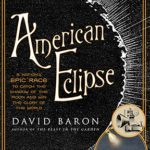
David Baron’s book American Eclipse: A Nation’s Epic Race to Catch the Shadow of the Moon and Win the Glory of the World tells the story of the intrepid scientists who made their way out west to stand in the path of totality. Baron tells the stories of a young Thomas Edison and planet hunter James Craig Watson—as well as Maria Mitchell, the unflappable astronomer who led an all-female contingent of observers from Vassar College, defying the sexist conventions of the time barring women from science.
“I think Maria Mitchell’s story is my favorite,” Baron told Springs. Find the book at your favorite bookseller or at american-eclipse.com.
How to Reach the Path of Totality
These websites are filled with the maps, tips and info you’ll need to get the full experience of Eclipse Day on April 8, 2024.
NASA: Get NASA’s helpful guide to eye safety—yep, you need special glasses—plus tips on planning your eclipse party. science.nasa.gov
Eclipse 2024: Geek out on Xavier Jubier’s interactive Google map and find out precise times for any location of the eclipse. xjubier.free.fr
Great American Eclipse: Don’t miss their Top 10 list of great spots to witness the path of totality. greatamericaneclipse.com


