


To say it was unlikely for Dr. Vinh Chung to become a successful dermatologist in Colorado Springs is an understatement. Forced to flee their home in South Vietnam after its communist takeover when he was a child, Chung’s family was miraculously rescued after they were left to die at sea in a disabled boat with no supplies. They were brought to Fort Smith, Arkansas, to forge a new life. None of them spoke English. Vinh’s parents, who had owned and run a large, successful business, took manual labor jobs to support their 11 children.
Despite poverty, discrimination, and confusing language and cultural barriers, Vinh eventually worked his way through Harvard University. He and his wife, Leisle, respectively graduated from Harvard Medical School and Harvard Business School on the same day. And after several more years of specialty training, the couple chose to make their home and start their medical practice in Colorado Springs in 2009.
Today their Vanguard Skin Specialists will open its ninth location in Southern Colorado next month. He is a board-certified dermatologist and fellowship-trained Mohs surgeon, specializing in that micrographic procedure to treat and remove skin cancer. She is CEO of the independently owned practice. They often speak to groups about their experience of becoming American, and they have made giving back a priority of their lives and business. Understandably, Chung’s experience as a refugee and his family’s journey have shaped his life in profound ways.
“There’s no way I could be a skin cancer surgeon today without all of the investments in me,” Dr. Chung says. “I don’t care how successful anybody is, you’re never self-made. Somebody has invested in you and given you your opportunity or your skillset. There’s a Vietnamese proverb that goes, ‘When you eat the fruit, remember who planted the tree.’ To me, that’s the best illustration of generosity and gratitude.”
Refugees
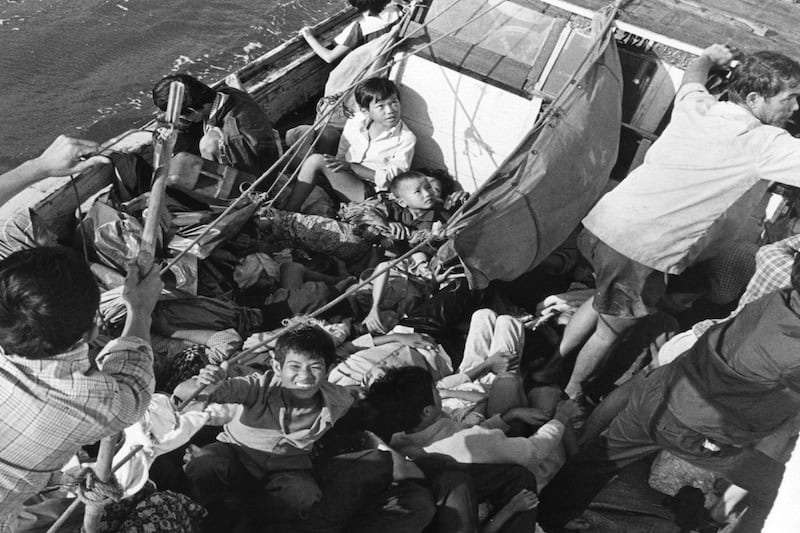
Chung was 3 years old when his family left South Vietnam in the waves of “boat people” fleeing their country’s brutal communist takeover following the Vietnam War. Once wealthy, the Chung family’s rice-milling business had been stripped away, leaving them in abject poverty and desperate enough to take to the sea in a tiny fishing boat — despite knowing that about 200,000 of their fellow Vietnamese had already died there in similar attempts to escape to a better life.
After facing attacks by pirates and being abandoned at sea by the Malaysian military in a disabled boat with no food, water or supplies, little hope remained for the Chungs and their fellow refugees. As they suffered from heat, exposure, dehydration and exhaustion, death seemed near. Miraculously, the boat was spotted and rescued by Seasweep, a ship seeking refugees operated by the Christian humanitarian aid organization World Vision.
The Chungs were eventually sponsored by a small Lutheran church in Fort Smith, Arkansas, and they were flown there to begin a new life. Their lives had been saved, but their journey was far from over.
Chung wrote about his story in the memoir Where the Wind Leads, including the arc of his and Leisle’s romance and her own family’s immigration from Korea. Their story was loosely portrayed in the 2020 Oscar-nominated, Golden Globe-winning film Minari, which was written and directed by Leisle’s brother, Lee Issac Chung.

Gratitude and Giving Back
Vinh Chung knows his story could have — perhaps statistically should have — ended much differently. That knowledge fuels a deep gratitude that guides his medical practice and life.
“Sometimes I catch myself, almost in a surreal state, just feeling so grateful because I know the only reason I’m able to use my hands to do the surgeries I do today is because my father used his hands for decades on the assembly line,” he says. “That connection to me is a vivid and daily reminder of just having a gratitude for what I do. Why do I do what I do? Well, because I want to plant trees. And that’s part of having meaning and purpose.”

Planting those figurative trees has motivated the Chungs and their Vanguard Skin Specialists colleagues to give back to others locally and around the world. They have worked with and supported local organizations, such as CASA and Lutheran Family Services. Vinh has served on the board of World Vision, and Vinh and Leisle and their children have traveled on service trips to various countries, including Cambodia, Rwanda and Haiti. Vanguard Skin Specialists also supports ongoing clean water projects in those countries.
“One of the pivotal moments in my life was when we went to Cambodia and visited this trauma recovery center for girls who have been sex trafficked,” Chung says. “Just meeting them was really eye-opening and heartbreaking at the same time, but also inspiring to know that we could do something to help them.”
Chung again traces that practice of giving back to his parents. “Growing up as one of 11 kids, we were very poor, but my father was writing a check to our church consistently and he would give to charities even though we would probably qualify for some of the charities,” Chung says.
Giving and serving others began as a discipline and practice of their faith, but Chung says it became a more personal source of joy. “Over time, the more that we did it, it really came to engaging with the people that we’re serving. Eventually something shifts where it becomes very emotional and personal, and then you find so much joy from doing it.”
Chung says he experienced a similar shift as he began his medical practice, transitioning from a focus on pursuing his career through many years of education to connecting with patients and their needs.
“My responsibility here as a leader of this practice is to respond to the needs of this community, and I think what gives me so much joy is that it’s not about me anymore. It’s about our communities. It’s about our patients. It’s about how we can serve them better,” Chung says. “At the very basic level, medicine is a service industry, and people who don’t recognize that will be burned out.”

Asian American Experience in Colorado Springs
As violence and racism against Asian Americans have grown and come to light on a national level in recent years, Chung sees connecting as individuals as an antidote.
“I think the solution is to help people understand that we’re humans, that we’re not different,” he says. “Fear is usually driven by seeing someone as different and viewing them as a threat. But I hope that when people see me, they see me first and foremost as a father, as a man, as a husband, as a doctor, and then my skin color is irrelevant.”
He says he has only experienced warmth and welcome in Colorado Springs. He has also been pleased to see Asian American representation grow in the health care field here since the beginning of his practice. “I’d love to see more Asian Americans as leaders in the business community,” he says, “more Asian professionals, attorneys, realtors, teachers.”
And more Asian restaurants. “What I think Colorado Springs can improve on is more Asian food,” he says with a laugh. “It’s gotten better over the last 15 years. So we celebrate every time a new Asian restaurant opens.”
As for Chung’s favorite aspects of Colorado Springs, he points to its outdoor beauty and access. “The most incredible thing about Colorado Springs are the mountains. Not only for their visual inspiration, but the mountains are where people go to have fun and play. I have lived in places where you have to have a lot of money to go to an exclusive club to play golf or you have a boat to go to the lake. But here in Colorado Springs, it doesn’t matter where you are in the socioeconomic ladder; we all have access to the same thing. And to me, that’s beautiful.”
Those mountains were a big draw for the Chungs when they chose to move here, as was a good place to raise a family. Vinh and Leisle now have four kids, ranging from their oldest in college at Harvard to the youngest, a 10-year-old who is adopted.
“He’s part Native American, part Caucasian and part African American,” Chung says. “I’m part Chinese and part Vietnamese. My wife is Korean. So we say we’re the all-American family.”
As with many things, talking about his kids brings things full circle for Dr. Chung. “It blows me away. My parents and my wife’s parents did not speak English. They never had the opportunity to formally learn English. My wife and I struggled with English, and our children today are masters at speech and debate at a championship level. Only in America, right?”


