

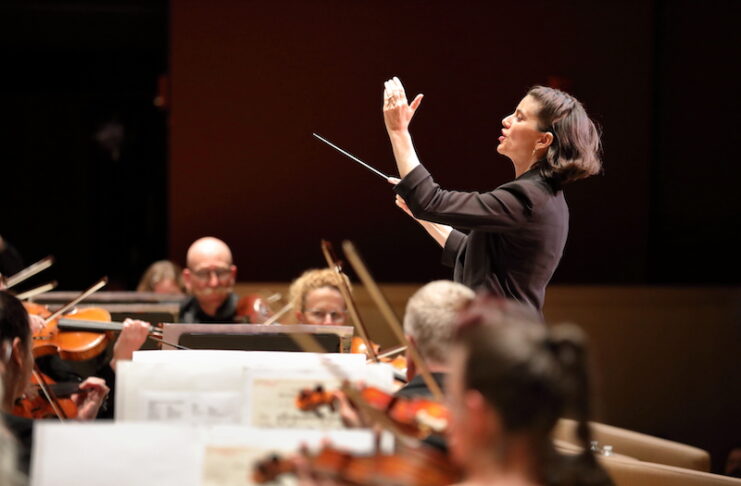
The music began 100 years ago. It was 1927 when Edwin Dietrich raised his baton and Grace Episcopal Church resonated with the sounds of the 27 musicians of the new Colorado Springs Symphony Ensemble. The names of those players have been lost to history. “What we do know is that it was a professional orchestra right from the start,” says Nathan Newbrough, president and CEO of the Colorado Springs Philharmonic.
“It was a burgeoning city back then, and they were asking questions that a city like that at that time should be asking, like: Who do we want to be? And what kind of place do we want to live in?” Newbrough adds.
Fast-forward to today, and the Colorado Springs Philharmonic is the oldest orchestra in Southern Colorado. Its century has included highs and lows that include moving from Palmer High School to a new, acoustically excellent Pikes Peak Center (1982), a bankruptcy restructuring and artist strike, and world-class music directors and musicians, both visiting and resident. (See more history below.) Through it all the Philharmonic has created a thriving artistic culture. And with Music Director Chloé Dufresne now at the creative helm, the Philharmonic is launching its centennial season amid a year of exciting projects.

“The Philharmonic’s story is profound, but unfinished,” Dufresne says. “In its 100th season, the Philharmonic will focus on the story of us, embracing narratives as a force for connection and change. The Centennial season concerts trace myths and memory, joy and reckoning — music that reflects who we are and who we are becoming. Familiar masterpieces stand alongside new voices, films unfold in sound and light, and genres meet with fearless curiosity.”
Last season, Dufresne became the first woman to lead the Philharmonic in its then 99 years. Due to the timing of her hiring, much of the season was also scheduled. This year the slate was clean, allowing her to shape the entire program for the landmark season. It’s an exciting schedule of concerts top to bottom.
“I’m very proud of it,” Dufresne says. “Every concert is big. Every concert has a piece that I profoundly love. So I’m actually excited for every one of the concerts. It will be a challenge for me and for the orchestra, every single concert, because they are big pieces that are really well known. It will be also a lot of fun.”
Find Your Symphony Style in the 2026-2027 Philharmonic Season
Have you been to hear the Philharmonic recently? Ever? Do you know your symphony style? We’re here to help whether or not you know your Bach from your Beethoven. Better yet, Chloé Dufresne is here to help. We asked for her input to help curate recommended ways to approach and enjoy the 100th Philharmonic season. Check them out below, and we’ll see you in the mezzanine!
Perfect Date Night Concerts
Looking for something romantic, passionate, fun or flirty? Try these concerts.
Verdi/Tchaikovsky, Feb. 20-21
Both the pain and pleasure of love play out in this February concert. Hint, hint: It’s close to Valentine’s Day. “For me, Tchaikovsky represents love,” Dufresne says. “There is something in the way the music sings that for me is very romantic and beautiful. Even if you or your partner don’t know classical music, you will find something you know in this concert.”
The Invention of Love, April 3-4
As part of the Counterpoint series, this concert at the Ent Center blends music and text brought to life by actors in what Dufresne calls “a reflection about love.” “We’ve created a sort of arc with a beginning of a relationship, the beginning of what is love and then the big love and then maybe the separation, the death and all of that. So it’s the life of love,” she says.
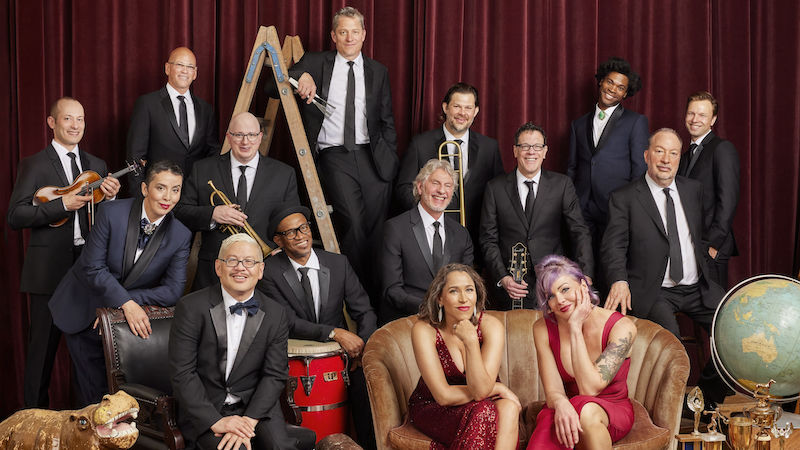
Pink Martini, March 5-6
Take a romp through symphonic pleasure spanning genres from Brazilian samba to vintage jazz and cabaret-infused classics with this eclectic international band.
For the First-Timers
Are you orchestrally curious? Try these especially approachable shows as an intro to the Philharmonic.
Music of the Knights, Oct. 2-3
Sir Elton John, Sir Paul McCartney, Sir Rod Stewart and Sir Andre Lloyd Webber have crafted songs known all over the world, so these tunes will be familiar to almost everyone. The Philharmonic will treat them with full symphonic color with help from influential drummer Carmine Appice and some of Broadway’s leading vocalists.
Tuesday Night in Paris, Jan. 16-17
As part of the Counterpoint series, this concert experience blends music by Debussy, Ravel, Stravinsky and Poulenc with poetry and writings from great French composers and writers: Stéphane Mallarmé, Pauline Viardot, Erick Satie and Maurice Maeterlinck.
“Tuesday Night in Paris captures the French atmosphere of the salons at the end of 19th century and beginning of the 20th century,” Dufresne says. “It’s set in [French poet] Stéphane Mallarmé’s house. So there will be poems. It’s just a gathering of composers. Actors will play the composers and reproduce a bit what it was like at this meeting of these artists every Tuesday night in Paris.”
Star Wars Return of the Jedi, Feb. 12-13
Do you love movies? The Philharmonic will play John Williams’ epic soundtrack live to a screening of the classic Star Wars film as part of the Philharmonic Pops series.
Adventures in Symphony
Join the Philharmonic as they push boundaries, dream big and embark on some epics, old and new.
Appalachian Spring, Oct. 17-18
This Counterpoint concert features music by Aaron Copland, John Adams and Steve Reich plus texts (performed by actors) that reflect on the American experience, offering content and perspective alongside these iconic works. Altogether, it’s an evening inspired by American stories of place, identity and landscape. “This one has a bit more modern music,” Dufresne says. “It’s a bit conceptual in a way, but I think it’s going to be very accessible. Steve Reich’s is a somewhat different kind of music than some of the others.”
Sibelius/Mahler, Jan. 23-24
This concert explores the restlessness of the human spirit, especially when confronted by a reality bigger than ourselves. Yes, there are works by Sibelius and Mahler, but also a contemporary piece by Kaija Saariaho’s, a woman composer from Finland. Dufresne calls it the biggest challenge of the season.
“This is wonderful music. It’s contemporary music — it’s very special in a way,” Dufresne says. “It’s a language that is a bit different. So the orchestra is not used to this kind of writing music. And I have very rarely conducted Kaija Saariaho’s music, but I am very much looking forward to it.”
The Inextinguishable, March 13-14
The Danish composer Carl Nielsen wrote this symphony during World War I and named it after “the elemental will to live.” The pieces in this program as a whole are deeper cuts. “The Inextinguishable is a big piece,” Dufresne says. “It’s very, very big, a lot of sound.”
Beethoven 9
Beethoven’s 9th Symphony is one of the most recognizable pieces of music of all time. “It’s a great symphony. It will be the first time for me to conduct it, and there will be a world premiere from Eunike Tanzil, our Composer-in-Residence,” Dufresne says. “This is also a challenge to do a world premiere because you cannot listen to the piece before. So it’s really the first time everybody hears it, including myself, apart from rehearsals.”

Harry Potter, Ronald Weasley and Hermione Granger in Harry Potter and the Sorcerer’s Stone. Photo courtesy of the Colorado Springs Philharmonic.
Philharmonic for the Whole Family
Free for Kids
Thanks to the Philharmonic’s Free for Kids program, almost every concert of the season is free for kids ages 7-17 with the purchase of an adult ticket.
“There is no bad time to bring the kids. We are very kid friendly,” Dufresne says. “Music should be part of our lives in general and not the lives of only old people. Kids are our future. We want them to be open-minded. We want them to be inspired, be imaginative. And I think music allows them to develop all these things.”
As for shows that are especially accessible for young listeners?
The Counterpoint Series
“The Counterpoint series is very accessible for kids because each concert is only one hour and a half or a bit shorter than that,” Dufresne says.
Harry Potter and the Sorcerer’s Stone in Concert, May 14-15
Watch the original Harry Potter movie while the Philharmonic plays the score live.

The Holiday Traditions
Music makes so many of our holiday memories, and the Philharmonic offers several seasonal favorites.
The Nutcracker, Nov. 27-29
Thanksgiving means it’s time for the Philharmonic to team up with the University of Oklahoma School of Dance and Colorado Springs Children’s Chorale to create holiday magic, featuring Clara, the Sugar Plum Fairy, the wicked Mouse King and Tchaikovsky’s enchanting score.
Christmas Symphony, Dec. 19-20
This joyous concert brings together a mix of favorite holiday songs, singalongs and local performers, including the Colorado Springs Children’s Chorale and other local choirs.
New Year’s Eve: Rhapsody in Blue, Dec. 30-31
Who doesn’t love a New Year’s Eve gala? You can ring in the new year with the Philharmonic’s musical version filled with sultry jazz tunes, movie soundtrack favorites, timeless classics and pop hits. Of course, the night concludes with the Gershwin favorite Rhapsody in Blue.
Explore the entire Philharmonic schedule and get tickets at csphilharmonic.org.
A Brief Timeline of the Colorado Springs Philharmonic History
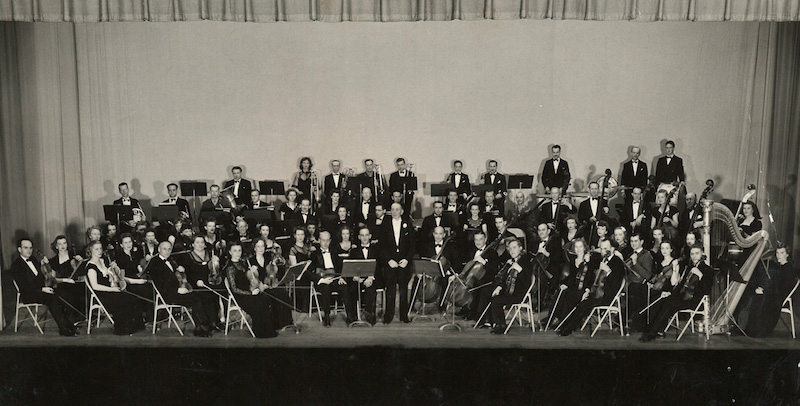
“The big meaning of the 100th anniversary is that it’s a moment in time to reflect on the past but also to plan and to sink our roots even deeper into this community because we know a community needs a soul,” says Philharmonic President and CEO Nathan Newbrough. “It needs a heartbeat, and we can be part of that life force for Colorado Springs.”
Here’s a broad timeline of Philharmonic history pulsing through the Pikes Peak region.
1927: Conductor Edwin Dietrich and 27 local musicians form the Colorado Springs Symphony Ensemble.
1928: Frederick Boothroyd became conductor, serving in the role for 26 years.
Dec. 12, 1941: Five days after the attack on Pearl Harbor, Julie Penrose and the El Pomar Foundation gave their first grant to the Colorado Springs Symphony in the amount of $1,000.
1954: The Colorado Springs Philharmonic Guild was formed by Bee Vradenburg, leading to continuing community and philanthropic support.
Late 1960s: The Colorado Springs Symphony Orchestra moved to the Palmer High School Auditorium as its regular home.
1970: Charles Ansbacher became the symphony’s music director, filling the role for 19 years.
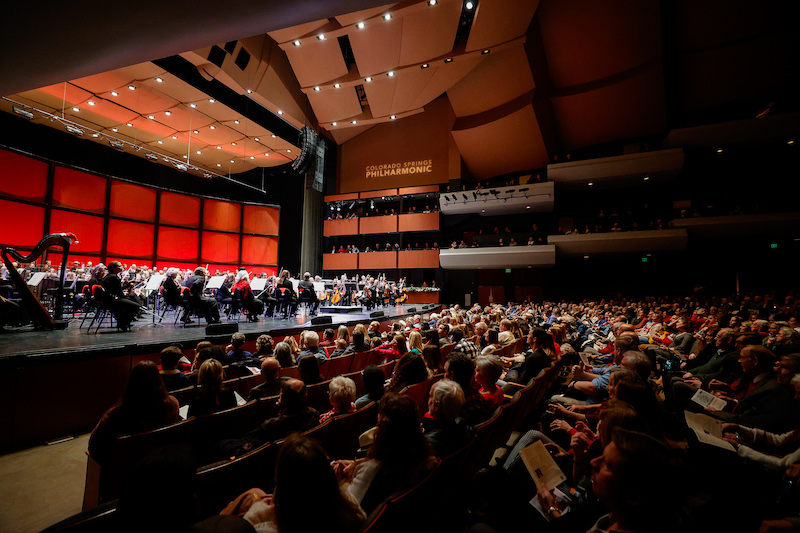
1982: The Pikes Peak Center opened as the permanent home of the Colorado Springs Symphony. “We’ve had great musicians all along, but they also have to be playing in the right kind of space where they can really be heard. The people matter; the space matters too,” Newbrough says. “What we have now is a building that still continues to amaze audiences by how good it sounds.”
2003: The Colorado Springs Symphony filed for bankruptcy. The musicians and conductors joined together to play several concerts anyway. That same year the Colorado Springs Philharmonic restructured and launched. Music director Lawrence Leighton Smith and conductor Thomas Wilson continued their roles.
2011: Spanish conductor Josep Caballé-Domenech began his 12-year tenure as music director and inspired a visionary era for the Philharmonic.
2024: The Colorado Springs Philharmonic launches the Center for Future Audiences to connect children and the community with the Philharmonic for generations to come.
2025: The Philharmonic hires Chloé Dufresne as the first woman to serve as its music director. “She’s a bright light in the artistic life of this city,” Newbrough says. “So that will go down as one of the great pieces of history for this orchestra.”


