


World-class athletes from around the country come to Colorado Springs — Olympic City USA — to train for Team USA and to pursue their Olympic dreams. You’ll be able to watch many of them on TV this summer in Paris as they become household names. But one of the greatest athletes in Colorado Springs history may not be as familiar: Dolphus Stroud.
Making the Olympic team in 2024 is a long, difficult road for hopefuls and their families. But just under 100 years ago, well before the U.S. Olympic & Paralympic Training Center and Olympic & Paralympic Museum were part of the fabric of the city, Stroud faced oppressive challenges on his road to the games.
Running Against Racism
Kelley “Dolphus” Stroud was probably the finest athlete to ever come out of Colorado Springs Schools District 11, says Leah Davis Witherow, curator of history at the Colorado Springs Pioneers Museum. In March 1928, Stroud broke the 25-year-old record for the fastest round-trip climb of Pikes Peak in three hours and 10 minutes. Often, he would summit the mountain by running from his family’s house on N. Walnut Street near Colorado College to the summit — and back.
Born in Indian Territory (present day Oklahoma) in 1907, Stroud and his family moved to Colorado Springs in 1910, leaving behind a state that had just codified “Grandfather Clauses,” which stipulated that only men whose grandfathers were eligible to vote could now vote themselves. The laws were an indirect way to disenfranchise black voters. The family hoped to pursue social, economic and political opportunity in Colorado, but challenges awaited in an era when racism and bigotry were on the rise.
“They arrived in a Colorado Springs that did not suffer the terrorism of the south,” Witherow says. “There were no laws on the books, but there were informal social codes that prohibited certain jobs, neighborhoods, movement, economic and social freedom.”
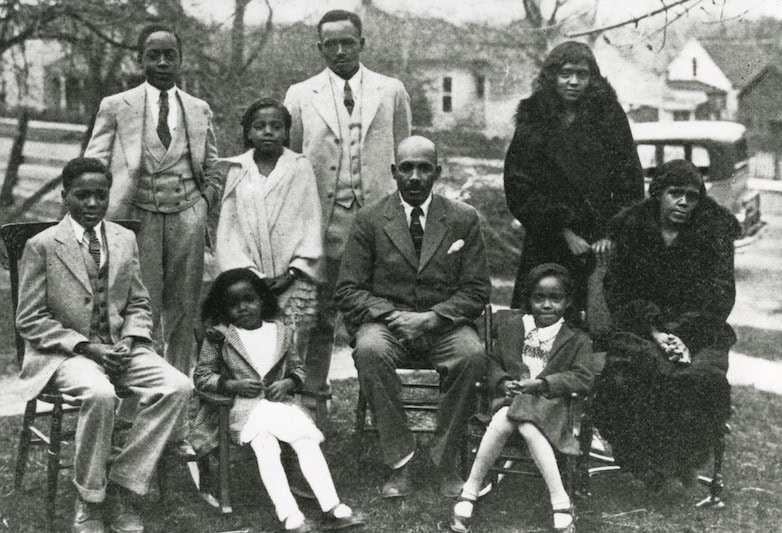
Though Stroud’s father, Kimbal Dolphus Stroud, was a former schoolteacher, Baptist minister, law student and politician, none of those professions were open to him in Colorado Springs. Instead, he found work loading coal at the Pikeview Coal Mine and hauling trash and household items, eventually getting his own hauling contracts and hiring workers.
“This was a way that he could make it work in a Colorado Springs and West that was increasingly intolerant to people of color,” says Witherow. “Their children experienced this too. The schools were integrated, but no black teachers were hired.”
But in a family that deeply valued education, they made it work. And Dolphus excelled at Bristol Elementary and Colorado Springs High School.
“School at home was tougher than school school,” Witherow says. “The kids were drilled, asked to debate each other. They were known as ‘those smart Stroud kids,’ and their parents wouldn’t expect anything less.”
Accepted to Harvard but unable to afford to go, Stroud attended Colorado College where he received multiple scholarships. He competed on the track team and won races across the region.
In June 1928, he won the 5,000-meter run in the regional track and field trials in Denver. Participants had been told that the top finishers would be awarded paid transportation and expenses to compete at the national Olympic Trials in Boston. The ultimate goal was to reach the 1928 Summer Olympics in Amsterdam.
But soon after the race, Stroud and his white track coach L.M. Hunt were told that there’d been a mistake — no such funding would be provided.
“He and his coach knew there had not been a mistake; it was because he was an African American athlete. There was no getting around that,” Witherow says.
Dolphus Stroud was determined to find a way to Boston. Wearing a sign that read “Denver to Olympia,” he walked, ran and hitchhiked his way there. His only companion was a trusty golf club he used as a walking stick. He made it, but only with six hours to spare before the race. Mentally and physically spent, an exhausted and malnourished Stroud collapsed during the sixth lap and was unable to finish the race.
“Dolphus’ story is a testament to how painful racism is to everyone involved,” says Witherow. “Not only was he denied the right to compete, but everyone else was denied the right to watch him.”
Stroud returned to Colorado College that fall, graduating with a degree in political science and receiving A’s in every class but one. He became the first black CC student ever elected to the prestigious national honor society Phi Beta Kappa and later received his master’s degree from the University of Mexico. His thesis, which chronicled the history of black people in America, was written entirely in Spanish. Stroud was inducted into the Colorado College Athletic Hall of Fame in 2006, and the club level of Robson Arena was named for him in 2021.

The Continuing Legacy of Dolphus Stroud
The story of Dolphus Stroud takes on added significance in today’s Colorado Springs, now known as Olympic City USA. For his daughter Juanita Stroud Martin, who lives in the city, there are lessons we can take from his story.
“We as citizens can use our best efforts to turn obstacles into stair steps in order to ensure that coming generations have the orientation, opportunities and facilities to develop their highest physical and mental talents for competing in this world,” she says.
From her father, Martin says she learned traits such as independence, prudence, perseverance, a love for education and enlightenment, love for the arts, self-confidence, purpose, family respect, love, humility and optimism.
“When ascending and descending Pikes Peak on his reflective runs — exercises that helped him to plan his next move — he carried his Bible,” Martin says. “He questioned the precepts and concepts because the lessons were difficult to accept in a segregated and racist local society, but he was able to extract that which helped him to navigate the hypocrisy. I never detected any bitterness or despair in the letters that my father wrote to me consistently; only dispassionate observations and facts as he perceived them.”
History can help teach us about our present and inform our future, and it can give us lessons that are still relevant today. For Witherow, despite the heartbreak and trauma of not being allowed to compete, Dolphus’ story showcases a tremendous role model who exhibited character, dedication and sheer force of will.
“His story tells us to never give up, fight for what is right, to shine, persevere,” Witherow says. “Dolphus wanted to become his best self, and he didn’t let anything stop him.”
The Stroud family has been impactful across generations in Colorado Springs and beyond. Among them, they have been business owners, newspaper publishers, scientists, military veterans, authors, teachers and even a New York City Chief Librarian. Dolphus’ mother, Lulu Magee Stroud, was the first black member of the Colorado Springs Fine Arts Center. His sister Lu Lu Stroud Pollard co-founded the Negro Historical Association of Colorado Springs, and another sister, Nina Stroud Pellerin, became the first black schoolteacher in Colorado Springs in 1954.
“The Stroud story is foundational to our understanding of the story of Colorado Springs in the early 21st century,” says Witherow. “Every single one of the Stroud family has contributed to this community. They have been generations of community builders, and there’s so many who still live in our community and work to make it better.”
Juanita Stroud Martin is a Navy veteran, teacher, author, and she has had an extensive career as a jazz musician, including as a member of the Stroud family band Sapphire. In 1986, they won third place in the Service Merchandise Battle of the Bands in Nashville.
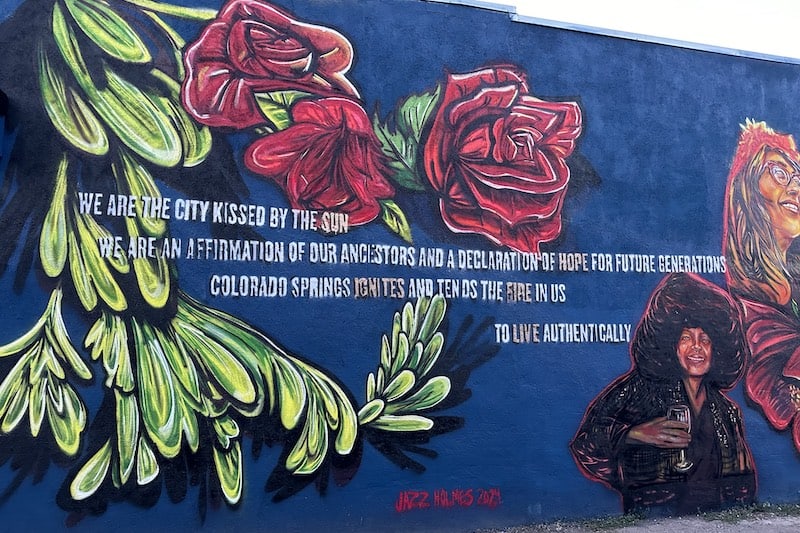
For this year’s Art on the Streets exhibit in downtown Colorado Springs, Pikes Peak Region Poet Laureate Ashley Cornelius and visual artist Jasmine Holmes collaborated on a mural called Sun Kissed. Found at the northeast corner of N. Cascade Avenue and E. Kiowa Street, the mural aims to showcase the depth of beauty and diversity of the Colorado Springs community. Noteworthy locals, including Martin, are featured alongside an original poem that Cornelius wrote after interviewing more than dozen community members.
It features a paragraph that might as well have been written about Dolphus Stroud.
“We are the city kissed by the sun.
We are an affirmation of our ancestors and a declaration of hope for future generations.
Colorado Springs ignites and tends the fire in us to live authentically.”
Learn More About the Remarkable Story of Dolphus Stroud
- The story of Kelley “Dolphus” Stroud and other impactful Stroud family members is represented in the Colorado Springs Pioneers Museum’s Any Place That Is North And West and COS@150. Read more in their article cspm.org.
- The stories of the whole Stroud family are chronicled on their website.
- Learn more about Dolphus Stroud’s time at Colorado College, including additional recollections from his daughter Juanita, on the Colorado College website.
- Learn more about the Stroud family in Juanita Stroud Martin’s book, A Taste of Life: Prisms – Through a Glass Darkly, available on Amazon.


