

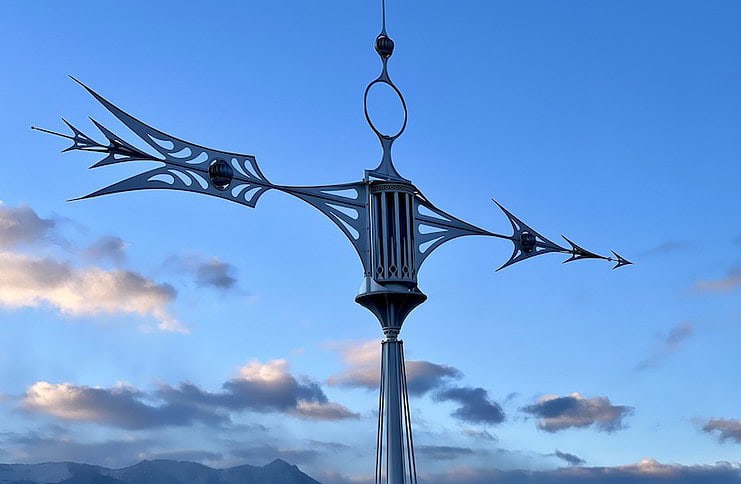
You’ve probably seen Starr Kempf’s kinetic sculptures if you’ve passed by the Ent Center for the Arts, the Creekwalk shopping center in Ivywild or even the artist’s former home in Cheyenne Canyon. Standing 40 or 60 feet tall in some cases, they’re hard to miss. But more than that, they are arresting, intriguing and inspiring. The towering metal statues take the forms of birds, arrows, weather vanes or fantastical windmills. And despite their size and industrial materials — welded steel and repurposed wind turbines — Kempf’s creations have a graceful, ethereal quality as they turn and spin and dance with the wind.
It’s no surprise that Starr Kempf’s kinetic sculptures are still inspiring people today, even after his death in the ’90s. But like his art, Kempf was a complex individual with a dark side to his legacy.
“Starr Kempf’s work is arguably among Colorado Springs’ most recognizable and popular, and he was a sculptor who was both celebrated and notorious,” says Dr. Joy Armstrong, director and curator of the Galleries of Contemporary Art (GOCA). “What many who witness these graceful public sculptures may not know is the tragic and angst-ridden story of Starr himself, belied by the enchanting beauty of his work.”
When GOCA put out a recent call for entries, more than 90 artists throughout the Pikes Peak region responded for the We Are the Sky exhibition, on display July 11 to Oct. 5. The challenge was not to respond to Kempf’s forms or subjects only, but instead to draw from the powerful, broader themes present in his life and work.
“Based on the themes that struck me as germane and by incorporating feedback from participants who shared their desire for broader representation, We Are the Sky became an exhibition not of artists literally responding to Starr Kempf’s artwork, but instead elevating relevant and poignant themes present throughout the artist’s life and oeuvre,” Armstrong says.
Those themes include “intentionally expanding the voices elevated by our arts community, addressing contemporary society’s urgent mental health crisis, and illuminating the role of innovation and collaboration, all contributing to a healthier and more just society through art.”
Who Was Starr Kempf?

Kempf first came to Colorado Springs as a teenager in the 1930s on a scholarship to study under the renowned artist Boardman Robinson at the Fine Arts Center of Colorado Springs. After serving in the U.S. Army Air Corp during World War II, Kempf continued his art studies at the Cleveland School of Arts. He and his wife and three children then returned to Colorado Springs, and Kempf built them a house and most of its furnishings in Cheyenne Canyon.
He also wrote novels and plays and built a foundry where he created and cast bronze sculptures, many depicting seemingly anguished or tortured figures. By the 1970s, Starr’s work moved into monumental metal sculptures, and he erected many in the yard of his home. Those kinetic sculptures remained Kempf’s focus and passion until he took his life in 1995.
Growing up in the Springs, Armstrong remembers driving by with her family to see the whimsical sculptures in Kempf’s yard. Some close neighbors had even helped Kempf to construct some of them. But after his death, relations between neighbors and one of Kempf’s daughters escalated to extremely contentious levels over tour bookings to the property. Eventually, some of the sculptures were removed from the Kempf family home and put in storage after legal wrangling.
Starr Kempf’s kinetic sculptures reemerged publicly when the Ent Center for the Arts opened at UCCS in 2018. Under the leadership of Kempf’s grandson Joshua Kempf on behalf of the artist’s estate, three of the large sculpture’s — Sunrise Serenade, Metronome and Space Needle — were set up outside the Ent Center on long-term loan. The works make a perfect pairing with the unique modern architecture of the Ent Center building.
In recent years, the family also loaned several more Kempf sculptures to line the trails and walkways along Cheyenne Creek at the Creekwalk shopping center in the Ivywild neighborhood. A large plaque there outlines his biography, and photos show Kempf at work on his famous sculptures.
The Ent Center for the Arts Honors Starr Kempf

The idea for an exhibition paying tribute to Starr Kempf began with Daisy McGowan, the former director of GOCA, Armstrong says. When Armstrong stepped into the role of director in 2022, she was “delighted” to hear about the plans but wanted to expand them further with local creatives. To her knowledge, the open call for entries was GOCA’s first, at least in recent history. Her hope was to encounter new artists in the region and to expand community through creative practice.
“In this way, along with so many others, We Are the Sky is already an unabashed success. It is an honor to be part of bringing so many talents together through this truly collaborative effort,” Armstrong says. “Throughout the next three months, you will get to know more than 60 artists in the gallery, public spaces, on stage and with pop-up offerings for an astounding 20 artworks in total.”
The participating artists run the gamut from well known to emerging talent.
“What I appreciate about We Are the Sky is that it asks us to consider not just Starr Kempf’s artwork but his life,” says Claire Swinford, a long-time local artist and arts professional who contributed to the exhibition. “The contributing artists have responded to that in so many different ways, each with their own grain of truth about what it means to be an artist, to be inspired by nature, to struggle with mental health, to provide for one’s family, to be misunderstood, etc. From that wide-angle view, Starr Kempf’s legacy gives all of us, including the people who visit the exhibit, a fresh jumping-off point from which to examine those very familiar silhouettes.”
Swinford says her work uses shapes of mountains, clouds and sculptures “to comment on the universal tensions between personal reality and shared memory, permanence and mutability, presence and absence. The ramparts of the Rockies appear chopped-up and disrupted by negative silhouettes that mimic the appearance of parts of Kempf sculptures. Because the piece itself can be turned on and off and rotated on the wall, I’m hoping it will encourage viewers to consider the subject in varying (and changing) degrees of abstraction depending on what story they want to tell.”
Leaving room for individual interpretation is a theme that would resonate with Kempf himself, as he describes in the following video of an interview with the 1980s TV show Celebration Express.
K8e Orr and Ashley Cornelius, the Poet Laureate of the Pikes Peak Region, used the forms of Starr Kempf’s kinetic sculptures as a launching point to play with light and dark. Their collaborative Aurora Atlas has lines of poetry inscribed on parts of a sculpture.
“This piece is inspired by the night sky being a reflection of identity, heritage and women empowerment,” Cornelius says. “The poem speaks to Black and Indigenous experiences with the night sky in terms of liberation, storytelling and legacy.”
“Knowing our past ancestral stories is extremely important and adds to the thickness of the artwork and the way we connect to the night sky,” Orr says.
They have also channeled a hope and possibility found in Kempf’s sculptures into their work. “We hope those who see our work find connection to the sky and know we are connected to a universe of possibilities; all we have to do is look up,” Cornelius says.
But We Are the Sky depicts a full spectrum of Kempf’s legacy and beyond. When I ask Armstrong what she might point out to Kempf himself if she could tour the exhibition with him, her answer is poignant.
“If I had the opportunity to share We Are the Sky with Starr Kempf, I would want him to understand the impact of his legacy on our creatives,” Armstrong says. “I might start with the title of the show itself, meant to describe our shared humanity as we coexist, innovate, struggle and dream. Together, we are the sky, infinite in possibility and constant in our striving, despite the turbulence and drama outside of our control. But it bears emphasizing that although our hearts beat in the same time and space, the nature of our respective lived experiences is nothing remotely close to universal; we are at once completely connected and individualized.”
She continues, “I would hope he could find a place of communion with many of the artworks, within the deeply personal layers present in each. Some convey furious screams into the void or expressions of heartbreak and grief, while others are celebrations of perseverance, authenticity and love, or purely the machinations of persistent curiosity — but all are as multidimensional as the experience of being alive, here and now. I would like to think he might relate to this complexity of the human experience.”
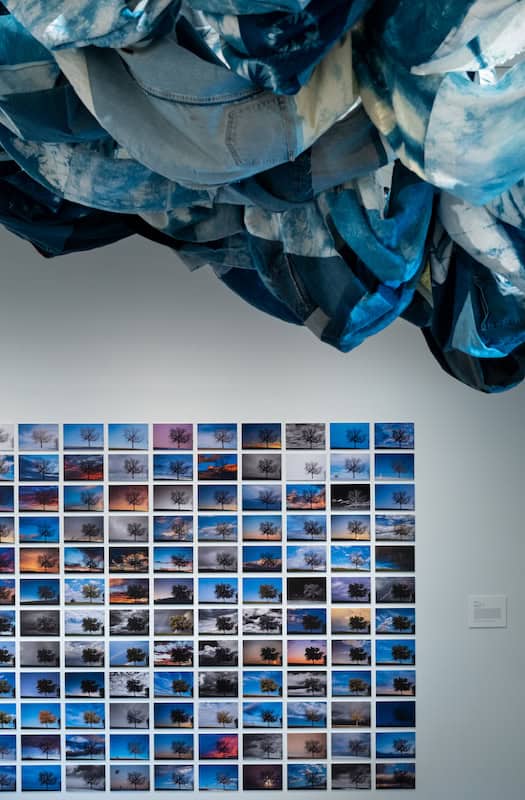
We Are the Sky Exhibition
We Are the Sky will be on display July 11 to Oct. 5. The exhibition is free and open to all in the Marie Walsh Sharpe Gallery at the Ent Center for the Arts. You can find hours and details at gocadigital.org.
We Are the Sky will also be coordinated with many special events, including the following:
Opening Event
July 11, 4-7 p.m. Free and open to all.
Gallery Talks
Three gallery talks will take place on a series of Saturdays. Free and open to all.
-
- July 20: 12-1 p.m.
- August 3: 12-1 p.m.
- August 17: 12-1 p.m.
Butterfly Effect Performance
Sept. 12, 6:30-8:00 p.m. in the Chapman Foundation Recital Hall, Ent Center for the Arts. Free, but registration is requested. Tickets and info.
What Kinda Brown Are You, Panel Discussion and Performance
Sept. 19, 6:00-8:30 p.m. in the Chapman Foundation Recital Hall and the Marie Walsh Sharpe Gallery, Ent Center for the Arts. Free, but registration is requested. Tickets and info.
Explore more of the Ent Center for the Arts and Colorado Springs with this Creative Stays itinerary for a visit to the Pikes Peak region by Ent Center Executive Director David Siegel.


