

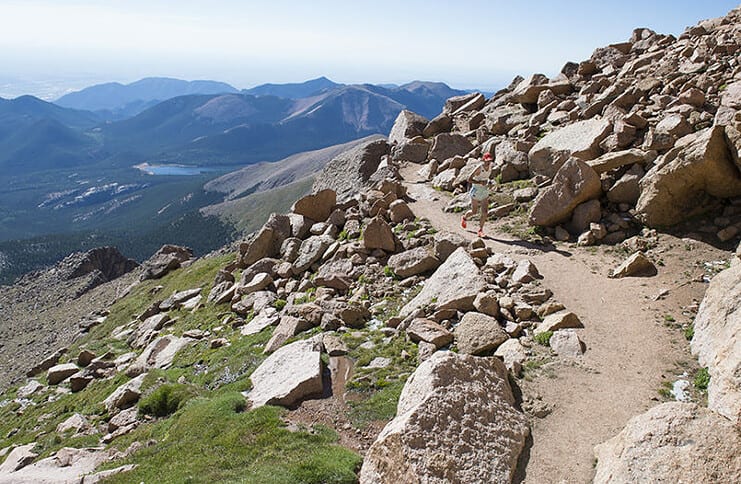
Colorado’s 14ers call to explorers from all walks of life to take in the forever views, thin air and bragging rights of “peak-bagging.” According to the latest report by the Colorado Fourteeners Initiative, about 279,000 hikers in 2022 headed up our 58 peaks rising over 14,000 feet. While those mountains range from expert-only to “walk-up” ready, they all require a certain level of physical fitness, knowledge and preparedness to reach the top — and safely make it back down. Summer is the season for climbing Colorado 14ers , but anytime is the right time to train and prepare for successful summiting.
1.Start Short — But Hit the Trail
“I am a big fan of people training for what they are going to do by doing it,” says Pete Lardy, director and owner of Pikes Peak Alpine School, who has more than 25 years of mountain guiding experience from the Rockies to the Himalayas. That means beginning on shorter, flatter hikes that are easily within the abilities of the individual.
“In order to climb a mountain, people need to be able to hike at a consistent pace for a solid hour before taking a break,” Lardy says. “Once they are able to do this, they should work up to steeper and longer hikes. Hike for an hour, take a short break, hike for another hour, take another break.”
The goal is to increase distance and elevation until you’re able to hike at an efficient pace for three to four hours. Lardy recommends starting to carry a 10- to 20-pound pack as hikes lengthen and stamina improves.
“A trip up Barr Trail to Barr Camp and back is a great litmus test,” says Sean O’Day, cross-country and track coach at Cheyenne Mountain High School, who has also summited Colorado’s highest 100 peaks.
2. Alternate Aerobic and Interval Training
Regular aerobic exercise should go hand in hand with the increasingly longer hikes. “Any endurance activity is going to help, whether it be hiking, running, rowing, biking or swimming,” O’Day says. “As for how much, there’s no simple answer, but most folks who exercise 60 minutes a day, three days a week are probably going to have the fitness they need to complete the easier Colorado 14ers.”
Adding interval training — short bursts of high intensity exercise with low-intensity recovery periods — between days of aerobic conditioning will increase cardiovascular and muscular endurance, build strength and condition your body to recover more quickly.
For example, after a 15-minute warmup, alternate running at your maximum speed for 30 to 45 seconds immediately followed by a slow jog for 60 to 90 seconds. If you’re not a runner, you can alternate any high-intensity exercise for a short period, immediately followed by a slightly longer recovery period. Think jumping jacks, jump-rope, butt kicks (run in place, bringing your heels to your glutes), or squat jumps (squat until thighs are parallel to the ground, then jump straight up). Repeat these cycles for 15 to 20 minutes before starting a 10-minute cooldown, followed by stretching.
3. Self-Monitor in the Elements
Physical training is important, but so is mental awareness when it comes to alpine ventures. “Learning how to deal with the environment and being able to self-monitor and take care of yourself in that environment,” Lardy calls it. “You need to stop to apply sunscreen every couple hours and have a snack of about 150 calories. Don’t get too hot and sweaty, and not too cold and hypothermic.”
Those weekly hikes help to develop those skills and experience. For people seeking deeper knowledge and safety tips — or wanting to tackle one of the more technical 14ers — Lardy recommends taking a class or hiring a guide.
Reaching a 14er summit is a quintessential Colorado experience, but it’s only as good as making it back down safely. Then let the peak-bagging bragging begin.
Top Five Safety Tips for Your First Colorado 14ers
1. Start “easy.”
Choose a Class 1 mountain, such as Mount Bross or Quandary Peak, if it’s your first time. Just remember that easy is relative in the thinner air near 14,000 feet.
2. Know your 14er route…
… including elevation gain, mileage and trail nuances. The go-to guide is 14ers.com, and it is full of great resources including route descriptions, trail directions, photos, topo maps, difficulty ratings and more. The 14ers.com app also let’s you access all the directions, info and photos (if you download those ahead of time) for offline use when you’re out in the wild.
3. Check the conditions.
Hikers frequently post trip reports and trail conditions at 14ers.com, noting snowfields, obstacles and other helpful details. Get more safety tips and insights for summers following especially snowy winters in our article How to Summit Snowy 14ers This Summer.
4. Start early in the day.
Most experts say no later than 6 a.m. to avoid afternoon thunderstorms and deadly lightning. Yes, people die every year from lightning strikes. Know the weather forecast, and don’t force a climb in the face of bad weather.
5. Be prepared.
Lardy recommends always carrying a waterproof jacket and bringing clothes to layer. Carry at least two liters of water, enough food to fuel you for the entire hike (approximately 150 calories per hour), sunscreen and sunglasses.
6. Communicate your plan.
Let a friend or loved one at home know where you are going and your estimated time of return.
This article was originally published in June 2017 and was updated in June 2024.


