

Get ready to turn your eyes to the skies. The biennial Pikes Peak Regional Airshow has become one of the region’s most popular events, and it’s back this year, Sept. 19-20, 2026.
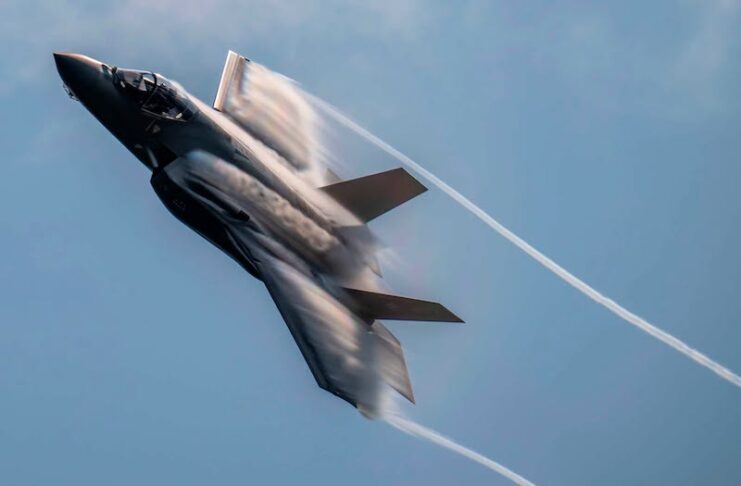
This year’s airshow will be headlined by the U.S. Air Force F-35A Demonstration Team and U.S. Navy’s F/A-18 Super Hornet Demonstration Team. And, as always, it will bring together military aviation, historic warbirds, aerobatic performers, educational exhibits and family-friendly entertainment for a full weekend just outside the Colorado Springs Airport.
“We are excited to welcome the F-35A Demo Team and F-18 Demo Team to Colorado Springs and continue the tradition of bringing world-class aviation entertainment to our community,” says Bill Klaers, president of the Pikes Peak Regional Airshow Board of Directors. “The Pikes Peak Regional Airshow celebrates our nation’s aviation heritage while showcasing the remarkable capabilities of today’s military aircraft. We are grateful for the continued support of our partners, sponsors, volunteers and the Colorado Springs Airport.”
In addition to the Demonstration Teams, attendees can expect a full lineup of performers and aircraft, including the U.S. Air Force Wings of Blue Parachute Team, historic warbirds from the National Museum of World War II Aviation, heritage flight demonstrations, aerobatic performances and a variety of static aircraft displays.
“This event celebrates our community’s deep military roots, honors aviation history, and creates memorable experiences for families and visitors from across the country,” says Megan Leatham, CEO of the Colorado Springs Sports Corporation. “We are proud to work alongside our partners to bring this incredible event back to Southern Colorado.”

The family-friendly airshow also offers aircraft displays, educational exhibits, food vendors, interactive experiences, premium seating options and opportunities to meet aviation professionals and military personnel. You can also get close to a variety of military and civilian aircraft displayed on the ground throughout the weekend.
All total, there will be more than 40 planes flying and on display at the Pikes Peak Regional Airshow. Gates open at 8:30 a.m. on Saturday and Sunday, and performances are expected to begin at 11 a.m. with an impressive lineup of flight performances straight through the day. Watch for a more detailed schedule closer to the airshow.
Here’s an introduction to some of the planes you’ll see performing at this year’s airshow in Colorado Springs.
The Performing Planes of the Pikes Peak Regional Airshow 2026
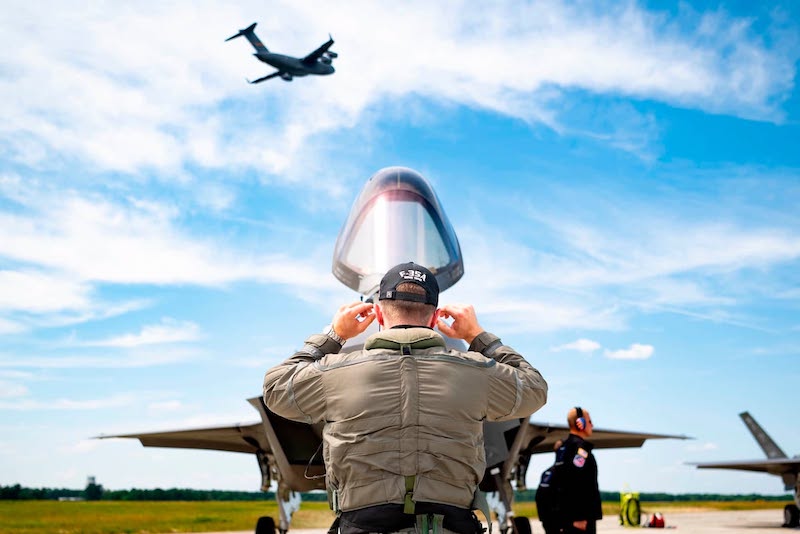
U.S. Air Force F-35A Demonstration Team
The F-35A is the U.S. Air Force’s latest fifth-generation fighter, and it is designed to replace the Air Force’s aging fleet of F-16 Fighting Falcons and A-10 Thunderbolt II’s, which have been the primary fighter aircraft for more than 20 years. The F-35A gives the Air Force the power to dominate the skies anytime, anywhere. The agile, versatile, high-performance plane is capable of executing 9G, and it combines stealth, sensor fusion and unprecedented situational awareness.
The F-35A Demonstration Team is part of the 388th Fighter Wing, based at Hill Air Force Base in Utah. Its mission is to “Deliver F-35 dominance … anytime, anywhere.” The wing maintains combat readiness to deploy, employ, and sustain F-35A Lightning II aircraft worldwide in support of national defense.
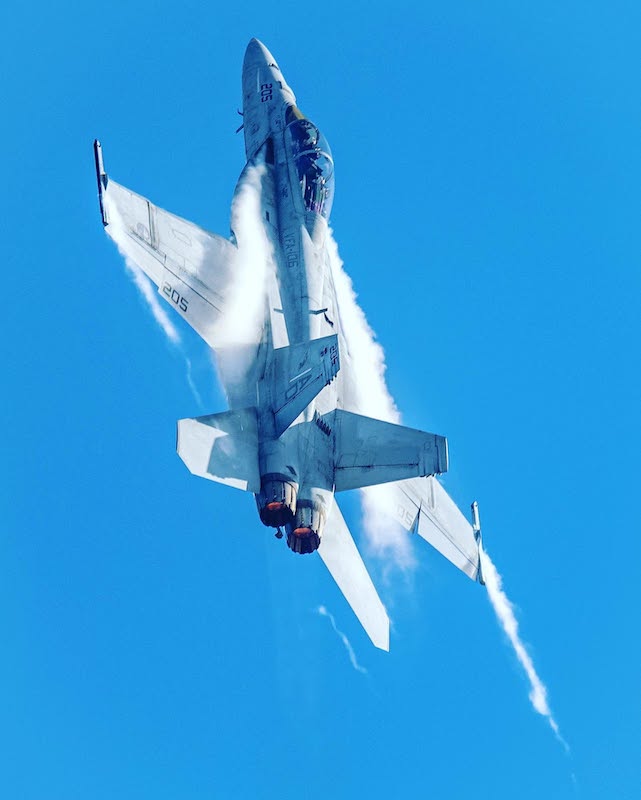
U.S. Navy F/A 18-F Super Hornet Demonstration Unit, aka “Rhino Demonstration Team”
The U.S. Navy F/A-18 Super Hornet Demonstration Team is better known as the Rhino Demo Team, and it showcases the formidable capabilities of the F/A-18-E/F Super Hornet at airshows and public events. Expect to see the team perform a series of dynamic maneuvers that highlight the aircraft’s exceptional speed, agility and versatility. The Super Hornet is known for its prowess as a carrier-based fighter, and it promotes inspiration and appreciation for naval aviation.

B-25J Mitchell
Nearly 10,000 of these twin-engine medium bombers were built by the end of World War II. The B-25 saw action in every major theater of World War II and gained fame as the aircraft that struck Tokyo in the morale-boosting Doolittle Raid in early 1942. Called PBJs in the Navy, the B-25s were used in many roles besides bombers, including as submarine patrol, trainers, reconnaissance and gunships.
After the war ended, many remained in service, operating across four decades. The plane served as a medium-altitude bomber, low-level ground attack aircraft, and mast-level attack aircraft against ships.
This Mitchell bomber, “In the Mood,” was built on August 29, 1944, and served its military career as a trainer until 1958. She was a spray tanker for about three years. “In the Mood” has flown off several carriers, was in the movie Pearl Harbor and is the only B-25 to takeoff from a carrier in dry dock.
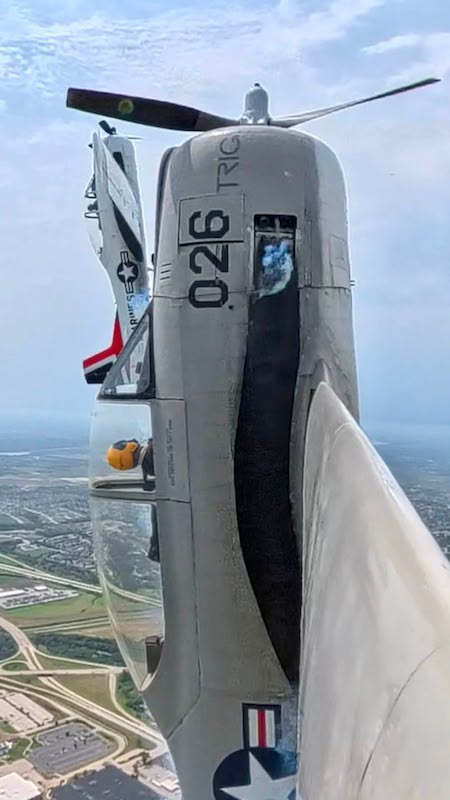
Trojan Phlyers T-28
The Trojan Phlyers are the world’s only formation aerobatic T-28 team, and they’ve been thrilling crowds for more than 25 years.
Immediately following World War II, the U.S. Department of Defense tapped into the expertise of the North American Aviation Company to develop the next generation of high-performance, advanced primary flight trainer to serve as a successor to the T-6 Texan. The result was the T-28 series of aircraft.
Mostly built in the 1950s and ’60s, the Navy used T-28s into the 1980s. Of the approximate 2,000 T-28 aircraft built, there are about 400 still flying worldwide. With a combined 2,850 horsepower, the noise and smoke of the Trojan Phlyers’ planes are always a fan favorite.
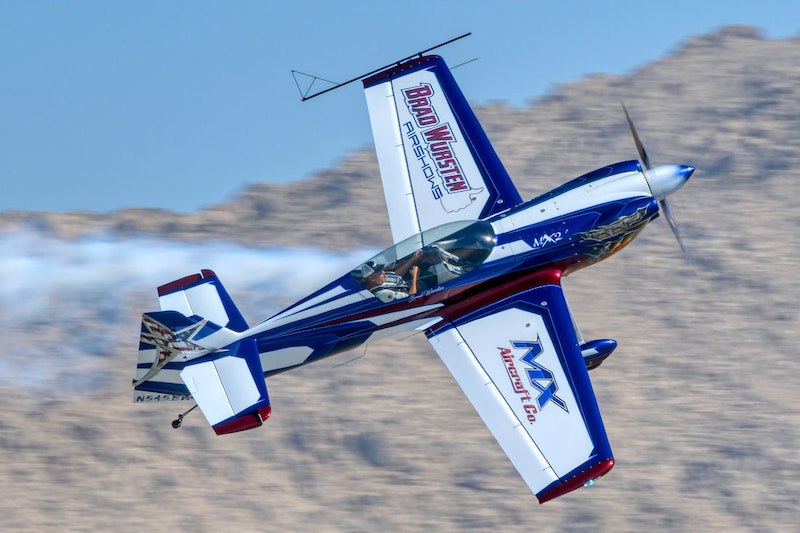
Brad Wursten Airshows
Brad Wursten dreamed of being a pilot from the age of 4. He grew up to become a breakout star in the airshow industry, logging nearly 4,000 hours in 50 different types of aircraft. The highlight of Wursten’s career has been thrilling fans with jaw-dropping performances at airshows and teaching youth about flying.
He will be performing in his MX2 at the Pikes Peak Regional Airshow. The aerobatic aircraft is an all-carbon fiber, two place high performance aircraft with unparalleled maneuverability in a two-place, aerobatic airplane.
P-38 Lightning
The twin-engine P-38 Lightning was one of the superior fighters of World War II. Though it flew in Europe, the P-38 was preferred in the Pacific because its second engine provided extra safety while flying over dense jungles and ocean. The P-38 was one of the first 400-mph fighter planes in history and one of the few with a 40,000-foot ceiling.
This particular P-38 was dug out of the jungle near Finschhafen Airfield, Papua New Guinea, where it had been buried following World War II. It was restored by WestPac Restorations in 2017. It has the most significant combat history of any of the National Museum of World War II Aviation’s aircraft. It was assigned to the 39th Fighter Squadron and is the only P-38 flying in the world today with known combat history.

Franklin’s Flying Circus
Kyle Franklin (Ben Whabnoski) is a legend in the airshow world and has become known as the “King of themed air show acts.” He has been performing at airshows full-time for over 25 years, performing aerial feats that include wing-walking, solo aerobatics, comedy acts, motorcycle to airplane transfers, stunt driving, aerial dogfight routines and more.
C-130 MAFFS
When all other civilian air tankers are activated to fight wildfires but further assistance is needed, the U.S. Forest Service can request the aid of the C-130s of the U.S. Air Force’s Modular Airborne Fire Fighting System (MAFFS). One Air Force Reserve and three Air National Guard locations participate in the MAFFS Program. The 302nd Airlift Wing, Peterson Space Force Base in Colorado Springs is the only Air Force Reserve unit supporting the aerial firefighting mission. A MAFFS C-130 will perform a demonstration at the Pikes Peak Air Show.

Brewster Corsair
The Chance Vought aerospace firm designed and initially built the F-4U Corsair, one of the best all-around Navy fighters of World War II. Because of the demand during WWII, manufacturers including Chance Vought subcontracted additional production of their planes to other companies. The Brewster Corporation was one of the companies to open a production line for Chance Vought Corsairs, but only built 735 Corsairs. The operation was taken over by the Navy because of quality and schedule issues, and it eventually went out of business. The F3A-1 (Corsair Mk. III) was the designation for the Brewster-built F4U-1. This is the only flying example of a Brewster-built Corsair in the world.
Douglas AD-5 Skyraider
The AD-5 Skyraider/(A-1E) was the U.S. Navy’s first single-seat torpedo and dive bomber. The plane was designed during World War II, and it entered service in 1946. The plane performed well in Korea and Vietnam. Both the Navy and Air Force used the AD-5/(A-1E) in Vietnam. Its primary mission was close air support for ground troops, and it was the most accurate bomber of the Vietnam War.

Douglas SBD Dauntless
The SBD Dauntless was borderline obsolete at the time of the attack on Pearl Harbor, but the plane surprisingly became a hero aircraft of the war. SBD stood for “Scout Bomber Douglas;” instead, it was often called “slow but deadly.” Nevertheless, the SBD Dauntless became the most effective U.S. dive bomber of World War II, sinking more Japanese ships than any other Allied bomber.
It was most notable at the Battle of Midway in 1942, when four Japanese aircraft carriers were sunk. The stout, sturdy Dauntless gave American pilots the ability and advantage of being able to dive at a nearly vertical 80-degrees on their bombing runs. And the Battle of Midway represented the first decisive naval victory over the forces of Imperial Japan.
In 2022, there were only four known SBDs still flying in the world.
P-51 Mustang
The Mustang was one of the best and well known American fighter planes used in World War II. The single-seat planes could fly remarkably fast at high altitudes. They entered combat in Europe during World War II in 1943, providing much needed long-range, high-altitude escorts for the U.S. bombing campaign against Germany.
Though advanced fighter jets had pushed the P-51 Mustangs to secondary status by the Korean War, the planes continued to prove themselves useful. Their longer range allowed them to strike targets in Korea that the short-range jets could not reach.
The P-51D ‘Stang Evil will be flying at the Pikes Peak Air Show. The magnificent specimen is the youngest “D” model Mustang still flying today.

F7F Tigercat
This twin-engine fighter was created to fly off of the decks of US Navy Midway-class aircraft carriers, but its low-speed performance characteristics made it generally unsuitable for carrier operations. Instead, it went on to be utilized as a land-based attack fighter by the United States Marine Corps instead. The Marine Corps preferred its firepower for close air support. The Tigercat production came too late to see action in World War II, but it did see action in the Korean War. Today there are only seven F7F Tigercats flying in the world.
TBM Avenger
The Grumman Avenger torpedo bombers came into service with the original designation of TBF, but it fared badly in its first combat at Midway in June 1942. Five out of six were shot down during an unescorted attack on Japanese ships.
In late 1942, the Eastern Division of General Motors built 550 similar aircraft designated as the TBM under a wartime contract with Grumman. The GM TBM-3 variants had added armor, wing guns and radar.
The TBM-3 could carry a 2,000-pound torpedo or 2,500 pounds of bombs. Throughout World War II, Avengers played a key role in sinking many Japanese warships in the Pacific and in protecting supply convoys from German submarines in the Atlantic Ocean while serving aboard escort carriers.
F3F Flying Barrel
Military technology changed drastically between World War I and World War II. The Grumman F3F-2 was the last Navy and Marine biplane fighter. It entered service in 1936, and retired from front-line service in 1941. Its short operational life underscored the Navy’s transition from biplanes to monoplanes. A total of 147 F3Fs of three variants were delivered to the Navy and Marines with this F3F-2 having an upgraded, 950 horsepower engine.
Proceeds from the airshow will benefit Colorado Springs aviation museums: the National Museum of World War II Aviation, the Fort Carson 4th Infantry Division Museum and the Peterson Air and Space Museum.
Find all the details at pprairshow.org
Explore More Military Aviation History
Many of the planes flying at the Pikes Peak Regional Airshow can be found at the National Museum of World War II Aviation in Colorado Springs. Read about the unique collection in Fly High at the National Museum of World War II Aviation.


