

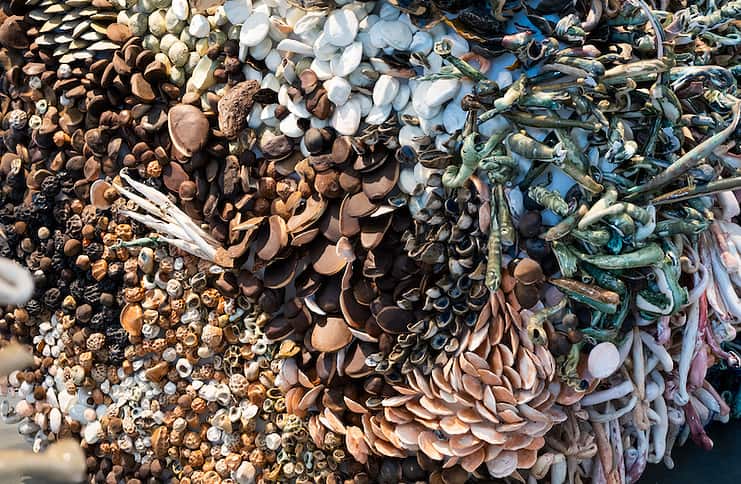
You’ll be forgiven for mistaking some of Martha Russo’s art for an intricate coral reef or some organic colony of spores, sprouts or microbiotic organisms you might discover deep within a lush rainforest. There’s a biological and even scientific quality to the regional artist’s work that offers some familiarity while also challenging the perceptions of what we are actually viewing. Russo says she likes to hear what other people see in her work. Shells, squid and aquatic flora are common from those with an ocean context, while giant hay bales are another common touchpoint for others. Some of the pieces are that large in Russo’s genre-defying, solo exhibition Caesura, opening Aug. 3 at the Galleries of Contemporary Art at UCCS (GOCA). To Russo, those massive sculptures are reminiscent of California’s giant, fallen redwood trees, cross-sectioned by rangers so people can explore their age and immensity.
Whatever you see in it, Russo’s work is an exercise in contradiction. There’s an intricacy and fragility to her sculptures. They pull you in to look closer while often making you question if these objects and forms are safe enough to get too close.
“Through caesura, I hope viewers will allow their lived experiences, unique ways of knowing and willingness to see deeply to guide their encounters with the exhibition, but also as they re-enter the world following their visit,” says Joy Armstrong, who curated the exhibition for GOCA. “There are thousands of details to absorb that might lead one to remember something personally experienced, from a specific memory to a felt sense of familiarity. There is a special balance between the individual and universal in Martha’s work that I believe can strike a chord in everyone when approached with openness to possibility, exploration, time and curiosity.”
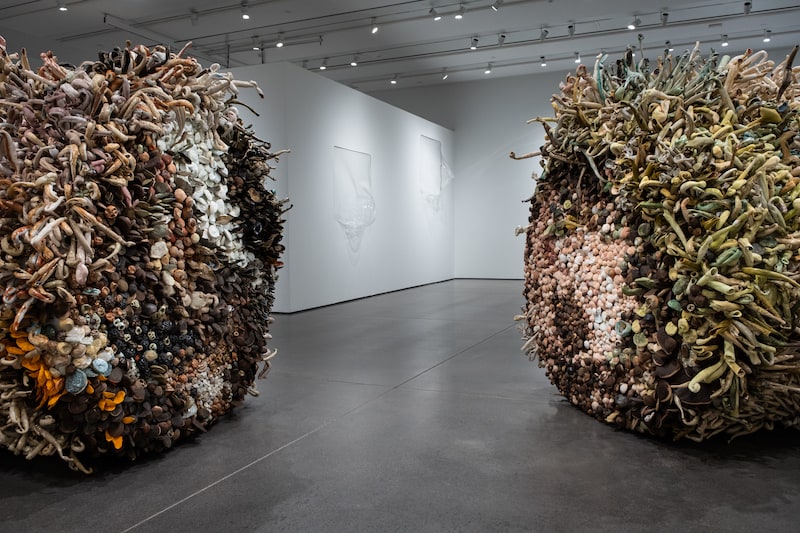
Caesura means a break, pause or interruption in the flow of a verse or melody. The exhibition is aptly named from Russo’s personal experience. Born into a family of medical professionals, Russo began pursuing a medical career of her own by earning a bachelor’s degree in developmental biology and psychology at Princeton University. She also had her sights on competing with the U.S Olympic Field Hockey Team — until she experienced a career-ending injury in 1984. That pause in her personal life led Russo into her creative practice, first through ceramics, which she then studied under renowned American artist Toshiko Takaezu, and then sculpture. Russo advanced her skills and pedigree by earning a master of fine arts degree at the University of Colorado, Boulder, studying under celebrated ceramicist Betty Woodman.
Russo now lives in Boulder where she lectures at the University of Colorado Boulder in the Art and Art History Department and the College of Engineering. Her work is in many private and public collections, including the Denver Art Museum, and she exhibits nationally at venues such as the Allan Stone Gallery in New York City, the Museum of Contemporary Art/Denver, the Miami Project, and The Santa Fe Art Institute.
Unlike Russo’s career-redirecting accident, a caesura is not unexpected but is rather an intentional moment to breathe between one phrase and the next. Literally and conceptually, a caesura occupies the in-between spaces as a place of rest, reflection and realignment. For the acclaimed artist, caesura has been eight years in the making. But the biological quality of the exhibition seems to be a natural continuation of her work and its place in her creative and life journey.
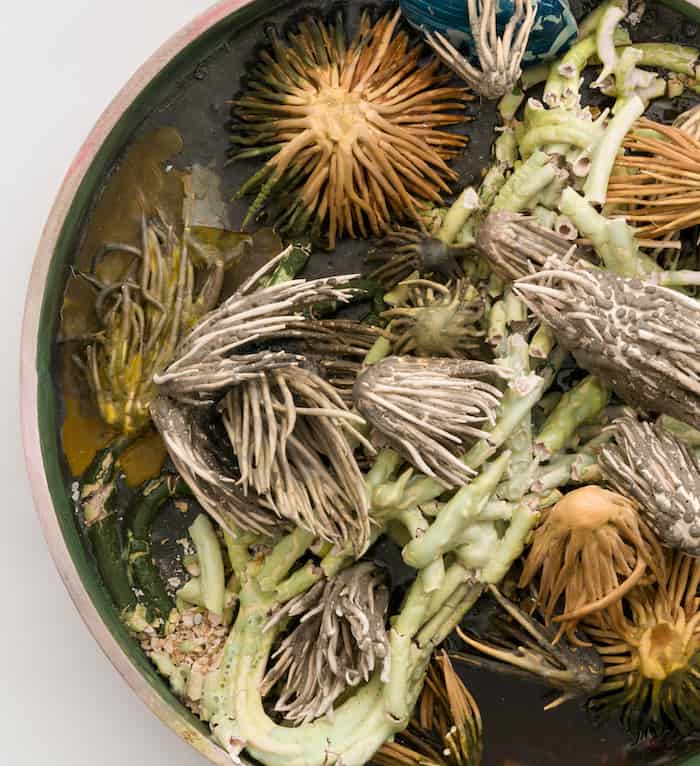
Armstrong says that Russo cannot be labeled as a ceramicist, despite her formal training in the medium. “Her unconventional approach to material use results in curious artworks, often large scale but composed out of many small elements, that integrate ceramics with found objects like nails, acrylic and wattles,” Armstrong says.
You might recognize wattles as those mesh tubes along roadsides stuffed with shredded wood or hay to reduce erosion. Those everyday objects are combined with Russo’s scientific background into experiments that GOCA’s artist statement calls “part mad scientist’s laboratory and part naturalist’s notebook.”
“Martha’s background in science and medicine incorporates into the conceptual subjects of her work and may remind the viewer of biological phenomena, microscopic and internal processes, or the growth and decay of the human experience,” Armstrong says.
It’s a creative world worth exploring.
Caesura will be on display Aug. 3 – Dec. 2, 2023, in the Marie Walsh Sharpe Gallery at GOCA in the Ent Center for the Arts at UCCS. The gallery hours are Thursday through Saturday, 1-6 p.m. or by appointment. You can find more info and register for free tickets at gocadigital.org.
Meet the Artist: Martha Russo
Caesura Opening Reception
Engage with the artist and guest curator, Joy Armstrong, at the opening reception on Thursday, Aug. 3, 5-8 p.m. with remarks at 6:30 p.m.
Visiting Artist and Critics Series Lecture
Join artist Martha Russo for this artist presentation, Sept 28 at 6 p.m. Registration is free and open to the public via gocadigital.org.
Read More
Free Summer Concerts in the Springs 2023
Colorado Springs Museums: Tour the Town
Local Poetry and the Black X-Men
Finding Farmers Markets in Colorado Springs


